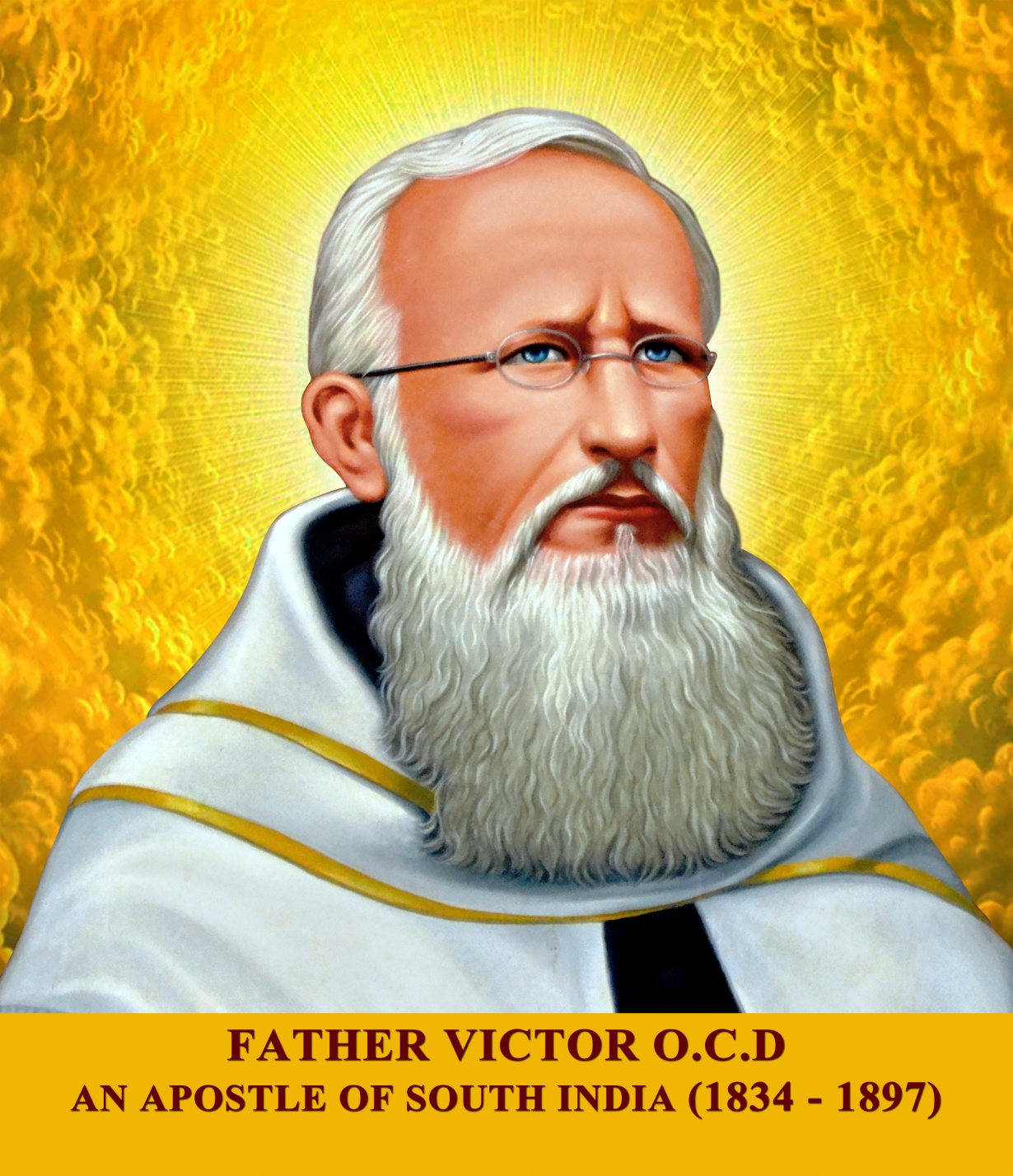
Rev. Fr.Victor O.C.D
An Apostle of South India
Early Life
Fr. Victor (1834-1897) was born in Ypres (Ieper) Belgium, on 19.06.1834, the 3rd of four children of pious and deeply Christian parents. At home, he received a firm and virile formation which helped him throughout his life to be courageous and not be afraid of any obstacle. His father was Louis Verlure born in 1792 in London. (UK) His mother was Virginie Eulaie Meerseman born on Ypres (Ieper) Belgium. His baptismal name was Charles Marie Aloys. He did his humanistic studies at St. Vincent's college in his native town of Ypres.
Brother Victor of St. Antony
Brother Victor of St. Antony got admission to the Carmelite Monastery in his native town of Ypres. In the year 1852, he received his religious name of Brother Victor of St. Antony. He made the profession of his religious vows on 9th May 1853. After the philosophical-theological studies done in Belgium, he received the priestly ordination in 1857.
A missionary in India
In the year 1858 when he met his father for the last time on his sick bed his beloved father gave him his last instruction: "Go, my child Charles, where God calls you. Be generous! Goodbye! Let us meet again in heaven". He wanted to be a missionary. But it was not easy to get permission from his superiors. Finally, he got it. He was sent to Rome to join the Seminary of Missions of the Carmelites. After some preliminary courses, he left Rome in September 1859 with his companions for his missionary field in India. They had arrived at Quilon, the center of the Vicariate. Destined to work in South Travancore he had to study both Malayalam and Tamil. He did it with all the enthusiasm of a zealous young missionary. In 1860 with his companion while visiting the entire Vicariate he came to Mulagumoodu. At that time Mulagumoodu was an unknown abandoned village, probably an abode of brigands. It was not a Catholic village though there were some Christians; there was nothing externally attractive. But Fr. Victor experienced an attraction to be there. He got permission from his Bishop and started work putting his trust in Him who called him. Fr. Victor and his brother Eugene converted more and more pagans and Hindus into Christianity. Sometimes whole villages responded positively to their appeal. Thousands of people voluntarily accepted Christianity through the love, affection, mercy, and grace of Fr. Victor.
Builder of Churches
Fr. Victor bought 40 acres (16 hectares) of land at Mulagumoodu for the social and economical development of the people. Fr. Victor and his brother Eugene together they planned; together they tried to execute their plan of changing the face of Mulagumoodu. A church and a presbytery rose there. Thus there was a place of worship where people could come and find peace and joy. According to the statistic of 1888, there were in the district of Mulagumoodu, 20 churches or chapels, not great ones, as at Quilon and Trivandrum, but modest ones were built by him.
Father of Orphans
1888 was a year of calamities for the whole district of Mulagumoodu and the neighboring districts. They had fallen into the grip of an epidemic of cholera. The epidemics increased the number of orphans. An orphanage became their dream. In 1868 the first orphanage was blessed at Mulagumoodu not far from the church. Their attention was drawn toward the children who were abandoned. A school for them was a necessity. Near every church, there should come up a school. Other schools also were built near the chapels he founded. To give life to orphans, he founded orphanages both for boys and girls. They were given not only education to learn, read and write, but they were also given training in various works like carpentry, masonry and tile works, etc. Once grown up they must be prepared to earn their food. By the year 1869, a small colony of families had come out of the orphanages. Fr. Victor was called the "Father of the poor and orphans."He was so kind, lovable and a man of hard work. People liked and loved him very much.
Founder of the convent of the Sisters
The good administration of his orphanages and the service to the womenfolk demanded the services of some religious Sisters. He arranged to have the service of the Canonesses St. Augustine of Ypres. The two brothers put their hands into the construction of an ample and worthy convent for them. In 1891 they laid the foundation stone and it took about six years to have it ready. The two brothers themselves became masons and carpenters. By the time the two volunteers, Marie Louise De-Meester and Marie Ursule reached Mulagumoodu, India on 7th November 1897 from Belgium to take possession of the newly constructed convent. The founder was no more to receive them. The convent they began at Mulagumoodu became later independent of the mother house and it became the cradle of a new Congregation called today ICM sisters.
Higher Offices
An Apostolic Vicar of Mangalore, the Roman congregation of propaganda appointed him as Apostolic Administrator there in the year 1876. Fr. Victor was appointed by the Bishop in 1891 as his Vicar General of Quilon. He was also a man of influence with the civil authorities, local as well as colonial. But notwithstanding these high offices, he remained well attached to his first love of Mulagumoodu. He continued his missionary work of bringing more to accept the true light that came to illuminate all who came to him. He had to face not only paganism (which according to the style of those days, they considered devil worshipers) but also the Protestants.
Last days
Fr. Victor was strong in health. Hence nobody thought of losing him so quickly. By 1897 while at Mulagumoodu a painful sickness got hold of him. Yet his zeal made him not care for it. But one day while he was giving direction for the construction of a new church at Mulagumoodu, all of a sudden he collapsed with a cerebral stroke. He did not murmur. He resigned himself to the loving hands of his Lord. He was taken to Quilon from Mulagumoodu. They're close to his Bishop he prepared himself for the last battle. His last words in Latin as reported were: Salutat Te, Christe Jesu, miles tuus moriturus, translated as: "I am your dying soldier salutes you, Christ Jesus". Jesus accepted the salute of his brave soldier and took him with Him. It happened on Sunday at six O'clock in the evening on 27th June 1897 when the Eucharist blessing was going on in the nearby church.
On the following morning, the body was taken to Mulagumoodu, first by boat to Trivandrum and from there to Mulagumoodu by bullock cart. To receive his mortal remains there was a very big crowd all in tears. On 30th June 1897, Wednesday at 11.30 AM took place the burial. His mortal remains lay in the Mulagumoodu church built by him where he experienced the first call of the Master to return to him.
Fr. Victor had all the qualities that make a good missionary: a jovial character, a will of steel, a golden heart, and everything adorned with sincere and solid piety. Fr. Victor was an important figure in laying the foundations of Christianity across much of South India. In the Dutch/Flemish book, "PATER VICTOR" Een Apostel Van Zuid- India (1834-1897), written by Fr. Andreas a Sta Maria, O.C.D published in the year 1929, Fr. Victor was mentioned as "An Apostle of South India". Hence it is evident that he was known as an Apostle of South India. His feast day is June 27th.